Building a Scalable Lead Management System
Our small but ambitious sales team was drowning in unstructured lead data scattered across Excel sheets, Cart abandonment, WhatsApp, form signups, call logs, and more. Without proper attribution, agents couldn’t be incentivized, conversion insights were lost, and the sales process lacked scalability. We attempted to onboard vendors like Leadsquared, Zoho, Freshdesk, but none could integrate all our data sources seamlessly. After failed vendor integrations and delays, we built our own LMS tailored to our data and sales workflows — and scaled revenue from ₹30L to ₹80L+/month.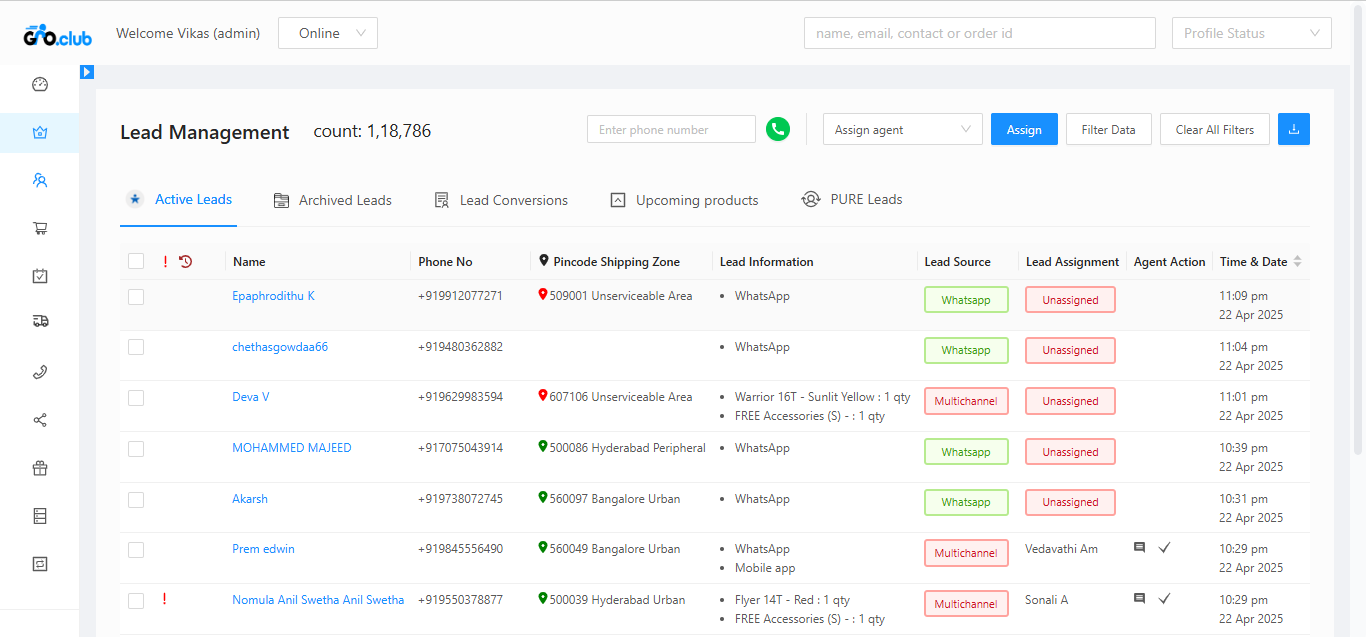
Problem Statement
Despite having a small and dedicated sales team, the actual lead handling process was broken:
-
No attribution mechanism — multiple agents worked on a single lead, and no one knew who closed the sale.
-
Leads were coming from WhatsApp, forms, cart abandonment, Tata Tele call logs, but there was no unified database.
-
Sales agents maintained their own Excel sheets and used separate dialers — creating chaos.
-
No follow-up tracking, no profiling, no automation.
-
If we ever introduced incentive-based programs, there was no way to measure it.
We even signed a contract with a vendor (LeadSquared), but they under-delivered and missed deadlines — we had no choice but to build internally.
Discovery and Approach
I sat with our CTO, CMO, and the sales team to identify the exact pain points and mapped the entire lead journey. At the same time, I collected API and webhook documentation from:
-
Shopify (cart abandonments)
-
MyAlice (WhatsApp)
-
Tata Tele Services(call logs and click to call integrations)
-
All website/form signups.
Once the data pipeline was mapped, we realized we had to redesign the CRM from the ground up(including APIs and the DB) — starting from lead stage instead of post-order since our previous version only supported post order stages. I led the redesign of our entire ERD and pushed for dev buy-in (it wasn’t easy, but explaining the impact helped).
Execution
The entire build was done in 3 sprints (~6 weeks) and released in phases. We started with a working PoC, then full dev + testing → feedback → release.
Key Product Features Delivered:
-
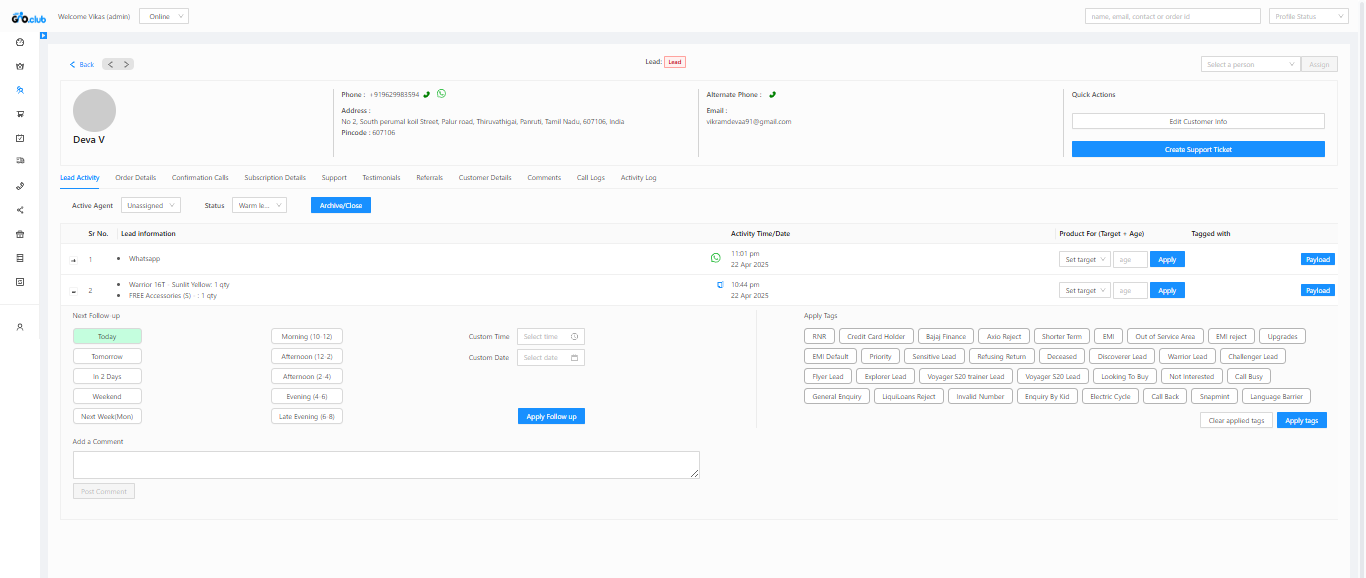
Lead Profiles with phone/email as unique identifiers.
-
Multi-channel tagging (WhatsApp, Form, Email, Cart, Call Logs).
-
Auto-tagging as hot/warm/cold (e.g., cart abandonments = hot).
-
Agent Attribution via rule-based logic with an ability for manual re-assignments.
-
Lead Enrichment via editable fields, comments and tags.
-
Follow-ups tracking for every lead interaction.
-
“My Leads” tab for agents with activity-based sorting.
-
Lead Archival System to remove dead leads from clutter.
-
PURE tab (Purchase, Upgrade, Renewal, Extend) for subscription customers. Basically a retention module.
-
Agent Dashboards showing performance, call logs, conversion stats.
-
Single-window calling via Tata Tele, removing copy-paste pain.
We also pushed infra upgrades — using AWS Lambda for webhook handling to reduce load on EC2 instances.
Business Impact
| Metric | Before | After |
|---|---|---|
| Sales Revenue | ₹25–30L/month | ₹80L+/ month |
| Lead Attribution | Manual/ None | Fully Automated |
| Agent Performance Tracking | Non-existent | Dashboard + KPIs |
| Lead Duplication & Errors | High | 99% Reduced |
| CRM Adoption (by sales team) | Low/ null | 100% usage post-training |
-
Incentives could now be implemented transparently.
-
Follow-ups improved agent efficiency.
-
Tags + comments made every lead “context-rich”.
-
Agent motivation soared as they could see their own performance daily.
Learnings
-
Building custom > Buying SaaS — when your needs are specific and scale is evolving.
-
Attribution logic is the backbone of performance-based sales teams.
-
Sales adoption comes from empathy + training → we ran daily training calls to drive real usage.
-
Internal resistance can be overcome if you show what it will unlock (incentives, performance, trust).
Tools and Stack
-
Frontend: React (internal CRM).
-
Backend: Node.js, AWS Lambda, EC2.
-
Integrations: Shopify, Tata Telephony, MyAlice, Mandrill(Mailchimp)
-
Design and wireframes: Miro, Microsoft PPT
-
Project management: Jira, standups